

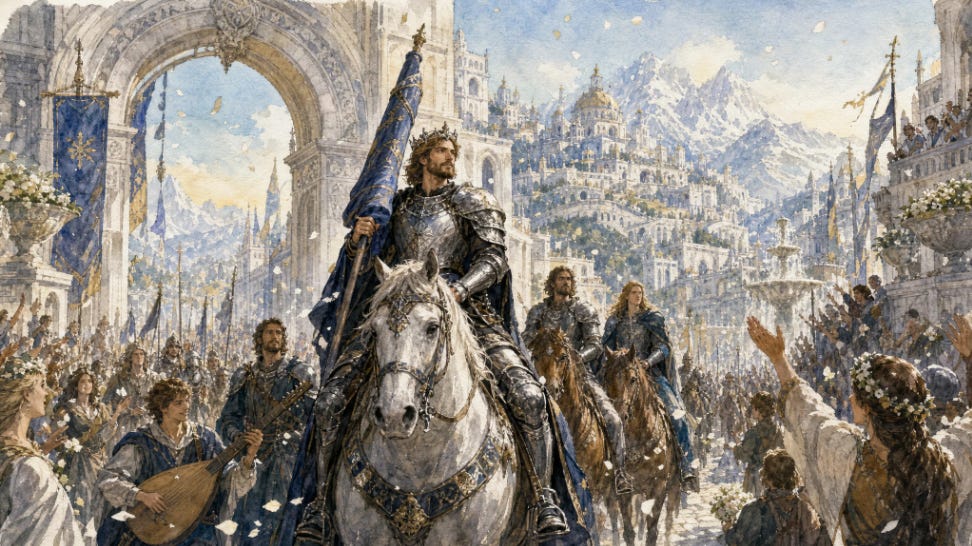
I first picked up The Lord of the Rings in high school.
I devoured it then and since my early twenties now try to do a full re-read of the trilogy every year. I know exactly how the plot unfolds. I know how the story ends. I have memorized most of the chapter titles. I know who lives and who dies. Yet every single time I get to certain scenes, I have to put the book down for a moment because I cannot see the words through my teary eyes.
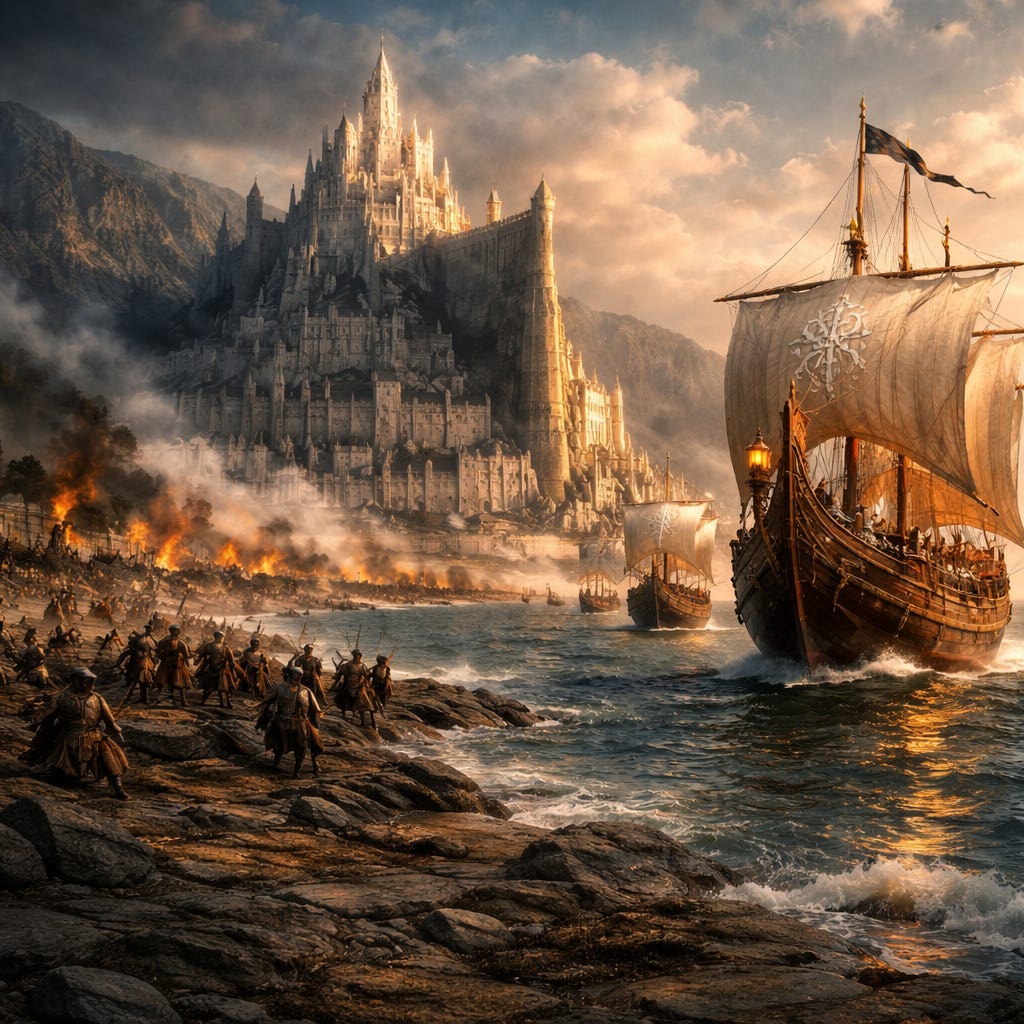
The horns of Rohan sounding across the field of the Pelennor as Théoden and the Riders crest the hill and the dawn breaks behind them. The black sails of the ships from the south arriving at the harbor of Minas Tirith, and the banner unfurling on the mast—not the banner the city was bracing for, but the standard of the rightful king. The moment at Helm's Deep when the fortress is about to fall, and Gandalf appears on the eastern ridge. The Eagles…
I cannot read these scenes and remain unaffected. The effect does not wear off with rereading. If anything, it gets stronger.
For years I thought this was just because I love the books. It probably is partly that. But I have come to think it's also because Tolkien is doing something specific in these scenes—something the rest of modern storytelling has mostly forgotten—and that something is connected, in ways I am still working out, to how the Christian life is actually built.
Tolkien had a word for it. He invented the word himself, because the words that already existed could not quite carry what he meant.
He called it eucatastrophe.
---
Tolkien introduced the term in a 1939 lecture called On Fairy-Stories. The Greek roots are simple. Eu, meaning good. Catastrophe literally meaning overturning—the sudden collapse of fortune that ends most ancient tragedies. Tolkien took the word, kept the suddenness, and replaced the disaster with rescue.
He thought eucatastrophe was the highest thing a story could do. He thought the moment of unlooked-for rescue gave the reader a glimpse of something true about reality itself—a joy that exists beyond the edges of the story and even beyond the world.
And he was explicit about why he thought this. Tolkien believed the Resurrection of Christ was the great eucatastrophe of human history. The actual, historical defeat of death. The rescue that came from outside, exactly when every visible resource inside the situation had failed. Everything else in the entire literary tradition, in his view, was a faint echo of that one real deliverance. All the smaller eucatastrophes in our stories work on us because they are pointing, knowingly or not, at the great one.
And the Christian story holds out one more eucatastrophe still ahead of us. The Resurrection has already happened. The King has already won. But the King will also return. The dead will rise. Every tear will be wiped away. The kingdom that has been held in trust for two thousand years will be restored to the One it was always meant to be ruled by, and the eternal glory we have been promised in Christ will arrive in full. The great rescue is not only behind us. It is also ahead of us. We live between.
This is the reason the scenes I cry at all share the same shape.
The horns of Rohan, the banner of the King, Gandalf at the eastern ridge—these are not just exciting plot points. They are the same pattern, three different times. The hope unlooked for. The help that arrives when nothing in the visible world warranted expecting it. The rescue that no one inside the story could see coming.
When I read these scenes, something in me recognizes them. Not because I am inside the story. Because I am inside a much bigger story that runs on the same pattern.
---
Let me dwell on each of them for a moment, because I think the specifics matter.
In The Two Towers, the situation at Helm's Deep is hopeless. Saruman's army has breached the outer walls. Théoden and his men have been driven back to the inner keep. The night has been long and brutal. The dawn is the last dawn most of them expect to see. Théoden, who has been broken by despair for most of the book, finds something at the bottom of himself and decides to ride out. Not because he thinks he can win. Because he would rather die on a horse than behind a wall.
They ride out into the morning. The orcs are everywhere. Then, Gandalf appears on the ridge to the east. The light catches him as the sun rises behind. The orcs scream in panic.
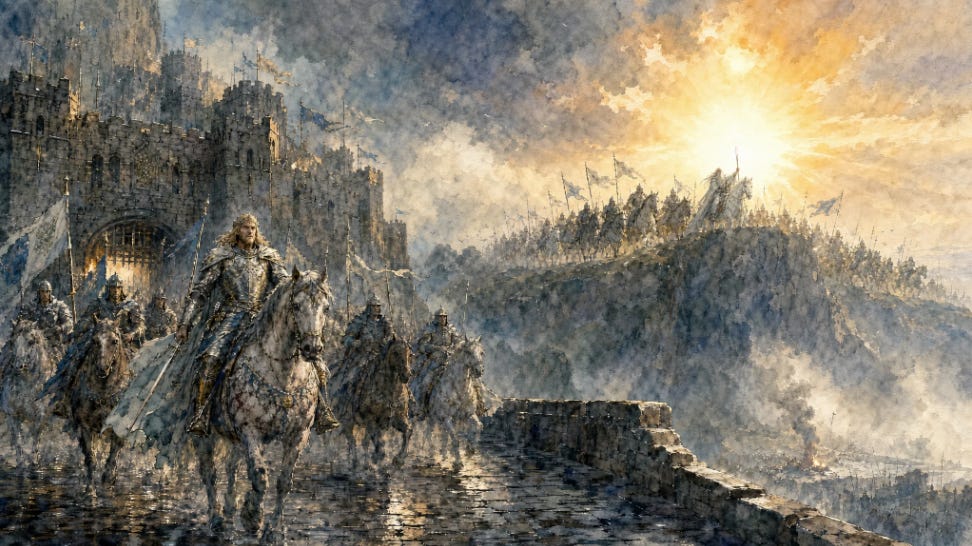
I have read this scene more times than I can count, and I cannot read it without crying.
In The Return of the King, the field of the Pelennor is worse. Minas Tirith is falling. Denethor has given himself over to the enemy. The Nazgûl are flying overhead. When out of the distance comes the sound of horns. Théoden and the Rohirrim have arrived—the help that was promised but no one believed would come in time.
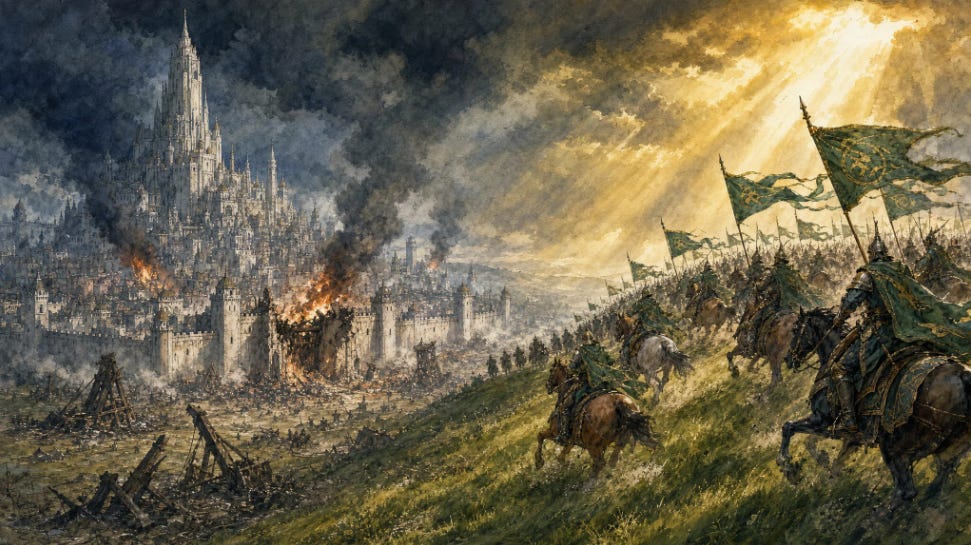
Théoden gives his great speech: Arise, arise, Riders of Théoden! The Rohirrim crest the hill. The horns sound across the field. And the riders charge into the fray.
And then, even worse for the city, even more lost—because Sauron's reinforcements are still coming—the black sails appear in the harbor. The ships of the southern raiders. The men of Gondor see them and despair. The reinforcements are reinforcements for the enemy. The day is finally, certainly lost.
Except the banner on the lead ship unfurls. And it is not the banner of the enemy. It is the white tree of Gondor. The seven stars. The high crown of Elendil. Wrought by Arwen and carried in secret. The ships do not carry the enemy. They carry the king. They carry Aragorn. The rightful king is coming, with the army he has been gathering since he passed through the Paths of the Dead. The help no one knew was on the way has arrived.
I cannot describe this scene without my chest going tight.
---
The thing I have come to understand about Tolkien is that he is not writing for cheap emotional effect. He is not setting up Helm's Deep so the rescue feels satisfying in the way a sports comeback feels satisfying. He is teaching the reader to recognize a pattern.
The pattern is this. In a fallen world, the situation often looks lost. Sometimes the situation is lost, by any reasonable accounting. The horns at the end of the long night are not the result of better planning by the heroes inside the keep. The banner on the ship is not something the men of Gondor produced by their own faithfulness. The help comes from outside the visible field. It arrives when the resources inside the situation have given out.
This is what Tolkien believed about the Christian story. The Resurrection is not the natural conclusion of Jesus's strong moral teaching. It is a rescue that came from outside the visible field. It was not produced by the disciples' faithfulness. It arrived after their faithfulness had completely failed—after they had abandoned him, denied him, and scattered.
Eucatastrophe is the pattern of all true rescue. It is the rescue that arrives from outside, when the resources inside the situation have given out.
This is why these scenes work on me at forty the same way they worked on me at sixteen. The pattern is hardwired. We were made to recognize it. The Christian who learns to recognize it in Tolkien is being trained to recognize it in the small rescues of his own life, and ultimately to trust that the great rescue is still coming.
---
I want to be careful here, because there is a shallow version of this that I want to avoid.
The shallow version says: trust God, and your problems will get suddenly better. Pray hard enough, and the help you need will arrive at the last minute. Have faith, and your version of the horns of Rohan will sound when you most need them.
That is not what Tolkien is teaching. It is not what the Bible teaches either. We are not promised a rescue from our suffering on the timeline we want. The cancer comes back. The business fails. The marriage ends. The prayer is not answered the way we hoped.
Eucatastrophe is not the promise that every small story in your life will resolve happily before you die. Eucatastrophe is the promise that the largest story is already resolved—and that another resolution, larger still, is on its way.
This changes how we wait.
If the great eucatastrophe is real—if Christ has been raised, and is returning to make all things new—then every small dark night is being lived in by people who know the dawn is real. The dawn is not just a metaphor. It is the real return of the real King, on a real day that has not yet come but will. Every small story that does not resolve in this life is being held by someone who knows the largest story will. Every prayer offered into silence is offered by someone who knows the silence is not the final word. Every business owner working through a slow quarter, every patient waiting for a scan, every parent waiting for the prodigal to come home—all of them are doing what the Stewards of Gondor were doing. Holding the kingdom while the King is away. Working faithfully. Waiting hopefully. Trusting that the horns are coming, even when they cannot yet be heard.
This is what Tolkien knew that most self-help misses. The stoics say: endure. The optimists say: it will work out. The positive thinkers say: believe and you'll receive. None of those is what Tolkien meant.
Tolkien meant: the situation may be much worse than you can see, and a rescue is coming that you cannot yet imagine. Both at the same time. The darkness is real. So is the dawn.
---
I expect to read The Lord of the Rings many more times before I die.
And every time, I expect to cry at the same scenes. The horns on the Pelennor. The banner on the ship. Gandalf at the eastern ridge.
I do not think this is sentimentality. I think it is recognition. Tolkien wrote the scenes that way because he knew what we were made to respond to. We were made to long for the unlooked-for deliverance. We were made to believe that the rescue is coming. We were made to hope, even from inside a dark keep at dawn, that someone is approaching from outside our line of sight.
The horns are coming. The banner will unfurl. The dawn will come. The King is returning.
In the meantime, we hold what we have been given in trust. We tend the kingdom that is not ours. We do the work in front of us. And we keep watching the eastern ridge—because what we are waiting for is not a metaphor. It is the King, returning. It is the eternal glory waiting on the other side of every story that did not end the way we wanted.