

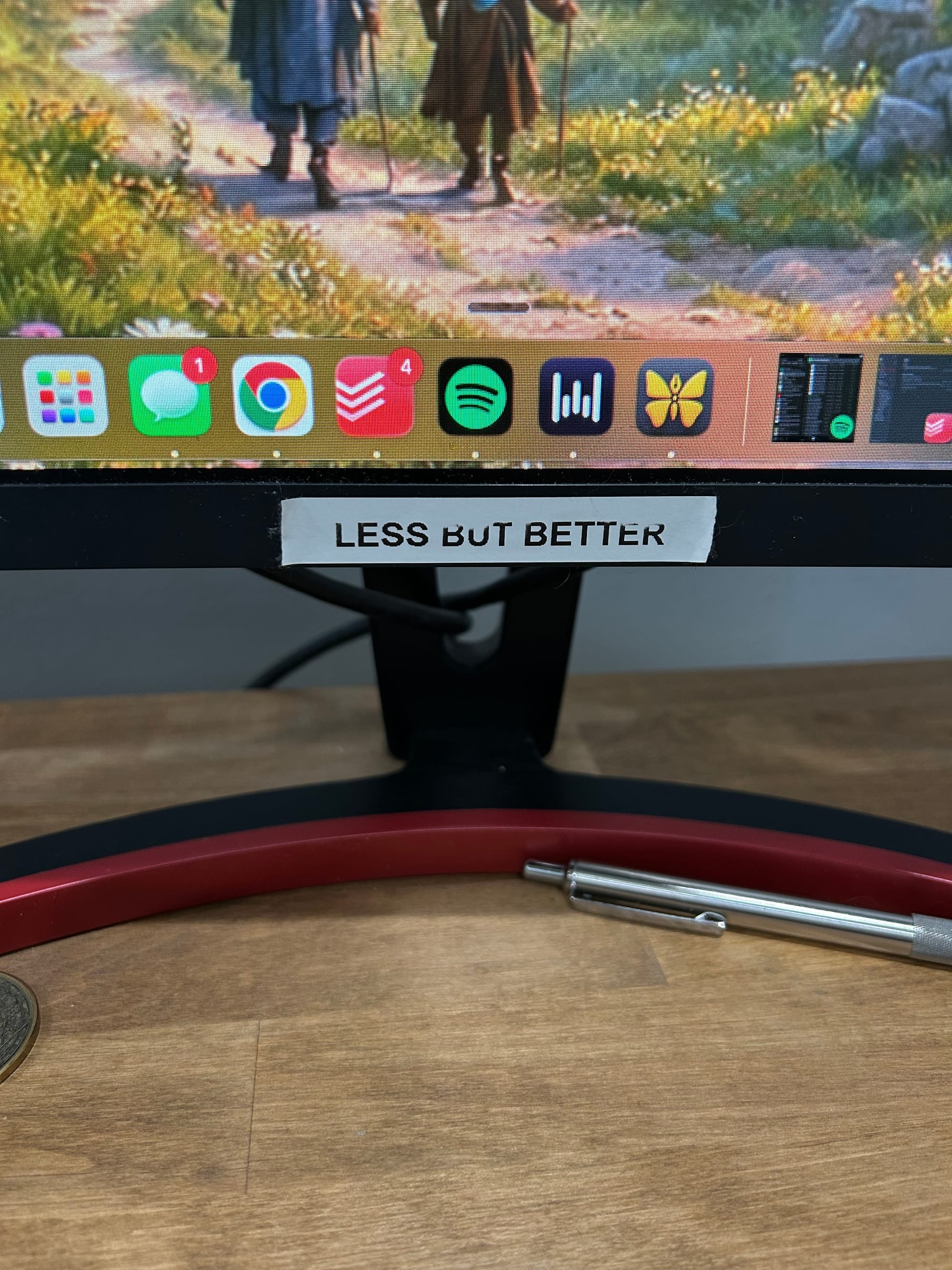
On the bottom of my computer monitor, there is a sticky note with three words on it.
Less, but better.
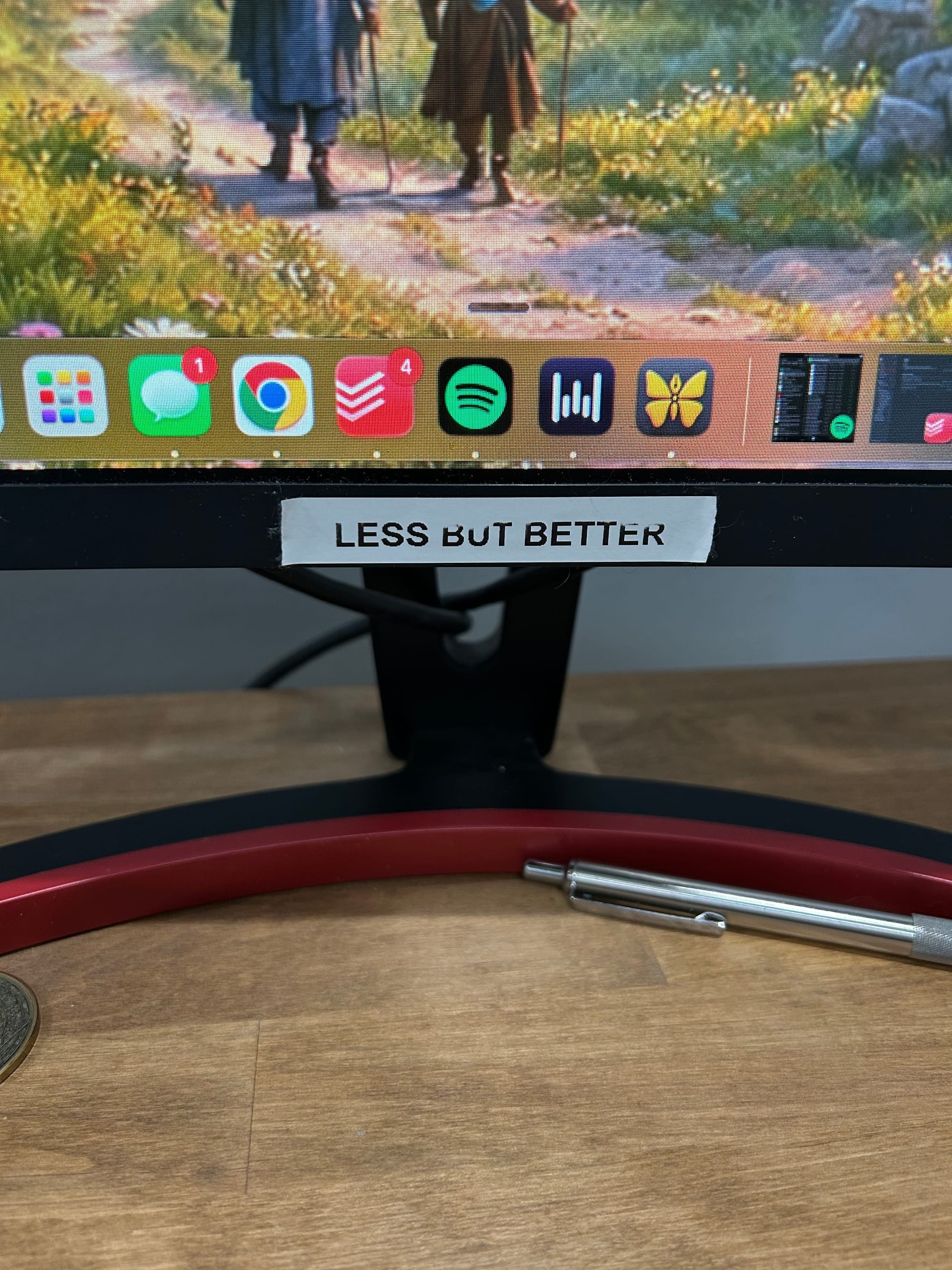
I put it there years ago, and I haven't taken it down. I look at it dozens of times a day. When I'm answering email. When I'm thinking about a new project. When I'm deciding whether to take a meeting that doesn't quite have a clear purpose. When I'm wondering if a piece of work is finished or if it needs another pass.
It's the closest thing I have to an operating principle for the way I work and live.
It’s aspirational. This is the way I want to work and live. I often fail, but this reminder keeps me focused.
At first glance, less, but better sounds like a productivity slogan. A clever way to say do fewer things, but do them well. And it is that—but if it were only that, it wouldn't be on my monitor. I have plenty of productivity advice on my bookshelf. None of it ends up on a sticky note three feet from my face.
The phrase is on my monitor because it isn't actually about productivity. It's about something deeper, and I want to spend a few minutes explaining what I think that is.
---
The phrase didn't originate with me. It didn't originate with the productivity world either.
It comes from a German industrial designer named Dieter Rams, who spent forty years at Braun in the second half of the twentieth century. He designed some of the most iconic consumer products of his generation—calculators, audio equipment, kitchen appliances. If you've ever held an Apple product and noticed how clean the design feels, you've already encountered Rams's influence. Jony Ive, the designer behind much of Apple's product line for two decades, has been open about how much of what he learned came directly from Rams.
Rams worked by a principle that became famous in design circles. In German, Weniger aber besser. In English, less, but better.
Rams meant something specific by it. He wasn't saying make products that are smaller or cheaper. He was saying strip away everything that doesn't serve the actual purpose of the thing, so that what remains can serve that purpose well. A calculator should help you calculate. Anything on the calculator that doesn't serve that core function is noise. Get rid of the noise. Keep what's essential. Make it excellent.
---
Greg McKeown picked up the phrase in his book Essentialism, published in 2014. His version is more applicable to our daily lives, and this is where I first heard the phrase.
McKeown isn't talking about industrial design—he's talking about the way most professionals run their lives. We say yes to everything. We treat every opportunity as roughly equal. We tell ourselves we can do it all. And then we wonder why we feel scattered, depleted, and behind.
McKeown's conclusion is that almost everything is noise. Very little is genuinely essential. The work of an essentialist—a word he coined for the book—is to distinguish the vital few from the trivial many. Most of what you spend your time on doesn't actually matter. The faster you can see that, the faster you can stop doing it.
I read Essentialism shortly after my cancer diagnosis. Cancer forced me to drop most of what I'd been doing because I no longer had the strength to do it. I was running my agency at maybe a third of my normal capacity. I genuinely could not work normal hours. And what I discovered, which McKeown predicts in the book, is that most of what I'd been doing didn't actually need to be done. The business kept running. The clients I served well stayed well-served. The projects I cut quietly disappeared and no one noticed.
I'd been treating more as the path to growth. Cancer forced me to treat less as the path forward. And the business didn't suffer. If anything, it got cleaner.
That's when I wrote less, but better on the sticky note. I needed the reminder.
---
Let’s go even deeper on this.
Here is what I didn't fully understand at the time.
The principle wasn't actually invented by Dieter Rams in the 1960s. It wasn't invented by Greg McKeown in 2014. Christians have been writing about it for two thousand years. They just didn't call it less, but better. They called it simplicity.
The contemporary Christian writer who has done the most to recover this tradition is Richard Foster. His book Celebration of Discipline, first published in 1978, is one of the most influential books on the Christian spiritual life in the last fifty years.
Foster's argument is that simplicity is not an aesthetic. It's not a lifestyle choice. It doesn’t mean stark white walls and empty countertops. It's not a productivity strategy. It's a spiritual discipline—one of twelve historic Christian disciplines that have been used by serious believers to clear out the noise of life and make space for God.
His working definition of simplicity, drawn from his Quaker tradition, is this: simplicity is the practice of holding the kingdom of God as the singular priority of life. Everything else is downstream of that one yes. When the Kingdom is your one yes, you become free to say no to nearly everything else. Not because the other things are bad, but because they aren't the one thing.
The Quakers had a word I love for what gets in the way of this. They called it cumber. All the stuff—possessions, obligations, divided loyalties, accumulating noise—that buries the freedom Christ purchased for us. The danger isn't usually that we go after big sins. The danger is that we get buried under small things we never quite chose, but never quite refused either.
When I read Foster for the first time, I realized that the phrase on my monitor wasn't an industrial design principle that happened to resonate with a Christian worldview. It was a Christian conviction that an industrial designer had described from a different angle. Rams was articulating in the language of products what the Christian church has been articulating in the language of souls for centuries.
Less, but better. Strip away what doesn't serve the actual purpose, so that what remains can serve that purpose well.
For Rams, the purpose was the function of the product.
For McKeown, the purpose is your highest contribution.
For Foster, the purpose is the kingdom of God.
Same logic of subtraction. Three different answers about what it's all for. The deepest one is Foster's. The more I sit with it, the more I think the principle has always been pointing at the Kingdom.
---
This matters for us because most of the small business owners I know are drowning in cumber.
Not in dramatic failures. In quiet accumulation.
Too many software subscriptions. Too many client commitments that should have ended a year ago. Too many "priorities." Too many newsletters in the inbox. Too many books half-finished on the nightstand. Too many side projects that don't really fit the main work. Too many obligations to people who probably wouldn't notice if you politely stepped back. Too many new business ideas.
I'm guilty of most of these. The temptation toward more is my default.
The optimization industry sells you more tools to manage the noise. Use this app. Try this morning routine. Buy this wearable. Read this book. The implicit promise is that the right system will let you do everything well.
It won't. You can't do everything well. The honest answer is to cut.
Most of the work of less, but better is not learning a new technique. It's giving yourself permission to subtract. To end the meeting series that no longer serves its purpose. To stop the client engagement that isn't bearing fruit. To unsubscribe from the newsletter you haven't actually read in six months. To say no to the obligation you took on because you didn't know how to say no when it was offered. To delete the app you opened twice and never used. To give away the equipment in the garage that you've been telling yourself you'd use someday.
For the Christian, this isn't just productivity. It's a spiritual discipline. It's clearing out the cumber so the Kingdom can come back into focus. It's the slow recovery of the singular yes from which a thousand free, easy noes flow.
For a small business owner, it means asking a question almost no one asks: what would this look like if we did less of it, but did it better? The honest answer might be uncomfortable. But it will be true.
---
I still look at the sticky note dozens of times a day. The work of subtracting never quite ends. Every season brings new noise. Every quarter, a new round of decisions about what to keep and what to release.
I am not very good at this. I drift toward more all the time. The note exists because I need the constant reminder, not because I have mastered the principle.
But I have come to believe that less, but better is one of the truest things I've encountered in many years of trying to figure out how to live well. It works for industrial design. It works for business. It works for Christian discipleship.
Christ is the one thing.
Less of everything else.
Better of what remains.